
Section 1: Introduction — Reexamining the Fundamental Nature of Gravity
Contemporary physics has achieved remarkable success in constructing two extraordinarily powerful theoretical frameworks for describing physical reality. Quantum mechanics provides a comprehensive account of matter and energy behavior at subatomic scales, while general relativity describes the dynamics of planets, stars, and galaxies through the geometry of spacetime. Each framework operates with remarkable precision within its respective domain.
However, a fundamental theoretical divide persists between these two paradigms.
The unification of quantum mechanics with gravitational theory represents one of the most significant outstanding problems in theoretical physics. Central to this challenge is gravity itself. Unlike the electromagnetic, strong nuclear, and weak nuclear interactions, gravity has proven resistant to quantum mechanical treatment. It exhibits distinct behavioral characteristics, operates across vastly different scales, and—most critically—employs an entirely different mathematical formalism.
Quantum mechanics expresses physical reality through probability distributions, discrete quantum states, and inherent uncertainty principles. General relativity, conversely, describes reality through continuous geometric curvature and smooth manifold structures. While both approaches demonstrate considerable explanatory power, they do not naturally integrate. The former describes discrete particles and quantized fields; the latter describes continuous spacetime geometry. The quantum framework is fundamentally discrete; the relativistic framework is fundamentally continuous.
Gravity occupies the central position within this theoretical divide.
It constitutes the sole fundamental interaction governing the largest structures in the observable universe, yet remains the least understood at a foundational level. We possess the mathematical tools to describe gravitational behavior and predict gravitational effects with considerable precision. However, when we pose the more fundamental question—what constitutes the essential nature of gravity—our theoretical frameworks yield fragmented and incomplete answers.
This situation raises an important theoretical possibility.
Perhaps the difficulty lies not in the mathematical formalism itself, but rather in the conceptual framing of the problem. Perhaps gravity should not be forced into conformity with existing theoretical models, but instead requires an entirely different conceptual approach—one that transcends the traditional dichotomy between force and geometry to examine underlying structural principles.
This examination proceeds from this premise.
Section 2: The Classical Paradigm — Gravity Conceptualized as Attractive Force
To comprehend how contemporary understanding of gravity developed, it is necessary to examine the first theoretical system that successfully unified terrestrial and celestial mechanics—the seminal work of Isaac Newton.
Prior to Newton's contributions, motion in the celestial realm and motion on Earth were considered fundamentally distinct phenomena. The descent of falling objects, the parabolic trajectory of projectiles, and the orbital motion of the Moon were regarded as separate categories of behavior governed by different principles. Newton's theoretical synthesis fundamentally transformed this conceptual framework.
His insight possessed profound simplicity: the same physical principle responsible for an apple's descent toward the ground governs the orbital dynamics of celestial bodies. No fundamental distinction existed between terrestrial and celestial realms—only a single, universal interaction.
This interaction became formalized as gravitational force.
Within Newton's theoretical framework, gravity is defined as an attractive force operating between masses. Every object possessing mass exerts an attractive influence on every other massive object. The magnitude of this attraction increases proportionally with mass and decreases with the square of the distance separating the objects. This mathematical framework enabled precise calculation of planetary motion, accurate prediction of trajectories, and revealed underlying order in systems previously considered chaotic.
For the first time in scientific history, the universe appeared governed by a single, mathematically consistent principle.
The explanatory success of this framework cannot be overstated. It enabled scientists to predict cometary returns with precision, map planetary orbits accurately, and explain tidal phenomena on Earth. Entire disciplines of engineering and applied physics were subsequently constructed upon these foundational principles. Newton's gravitational theory became one of the most powerful predictive instruments in the history of science.
Nevertheless, embedded within this remarkable success was a subtle but significant theoretical limitation.
Newton's framework describes how objects behave under gravitational influence, but it does not explain what gravity constitutes as a physical phenomenon.
Mass attracts mass—but through what physical mechanism?
The gravitational force appears to act instantaneously across distance, without any observable medium or physical process connecting the interacting bodies. No identified structure carries this interaction; no defined pathway exists through which the gravitational influence propagates. The interaction simply exists as given. The mathematical equations function correctly, the predictions correspond to observations, yet the underlying causal mechanism remains undefined.
This situation creates a subtle but important theoretical tension.
On one hand, the framework demonstrates extraordinary empirical effectiveness. On the other, it leaves unanswered the very question it purports to resolve. Gravity is treated as a fundamental given—an axiomatic input to the theoretical system rather than a phenomenon derivable from deeper structural principles.
During Newton's era, this was not regarded as a theoretical deficiency. The primary objectives were empirical accuracy and predictive capability, and Newton's framework delivered both with unprecedented success. However, as scientific inquiry advanced, the demand for deeper explanatory understanding intensified. Mere behavioral description became insufficient; the investigation shifted toward explaining causal origins and mechanisms.
Why does mass attract mass? Why does the gravitational interaction follow such precise mathematical relationships? Why do gravitationally bound systems organize into stable, periodic configurations rather than collapsing into disorder?
These questions persist beneath the surface of the classical framework.
Newton's theory provides mathematical descriptions of motion, predictive capability, and internal consistency—yet it does not furnish a structural explanation. It specifies what occurs and how to calculate it, but it does not reveal what is actually transpiring beneath the mathematical formalism.
That explanatory gap would remain unresolved until the next major theoretical revolution—one that would redefine gravity not as a force, but as something fundamentally geometric in character.
Section 3: The Relativistic Paradigm — Gravity Reconceptualized as Geometry
Centuries following Newton's foundational work, a new theoretical perspective emerged—one that would fundamentally transform our understanding of gravity. This paradigm shift came through the work of Albert Einstein, who redefined gravity not as a force, but as a property of space and time itself.
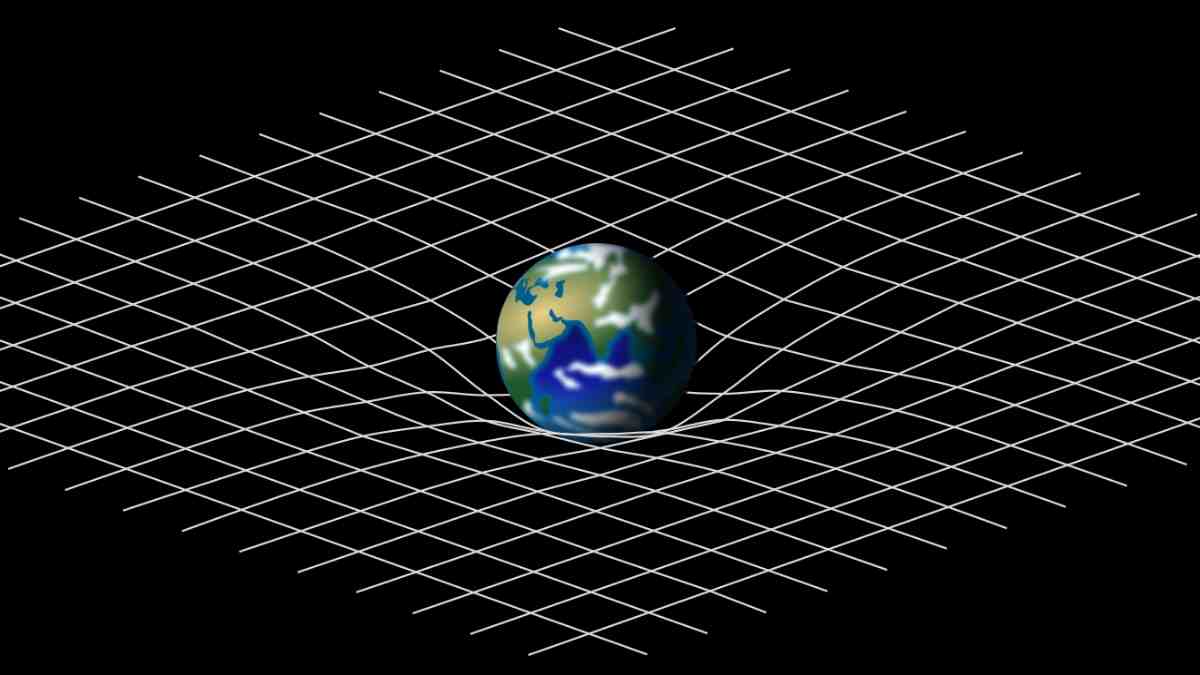
Within Einstein's theoretical framework, gravity no longer functions as something that attracts objects together. Instead, mass and energy induce curvature in spacetime, and objects traverse the geodesic paths defined by that curvature. What appears observationally as gravitational attraction is, within this framework, simply motion following the natural geometry of a distorted spacetime manifold.
A commonly employed pedagogical analogy involves a stretched elastic membrane. When a massive object is placed at the center, the surface deforms. Smaller objects moving across that surface will follow curved trajectories, not because they are being directly attracted, but because the space through which they move has been geometrically altered.
This conceptual approach replaced the notion of force with something more fundamental and mathematically elegant.
Objects are not acted upon at a distance. They respond to the geometric structure of spacetime itself.
The empirical success of this theoretical framework was immediate and profound. It explained phenomena that Newton's equations could not fully account for, including the precise perihelion precession of Mercury's orbit and the gravitational bending of light around massive objects. Predictions derived from Einstein's theory have been confirmed repeatedly through observation and experiment, establishing it as one of the most accurate descriptions of gravitational phenomena available.
Nevertheless, even within this framework, a familiar pattern begins to emerge.
Einstein's theory provides a powerful description of how gravity manifests behaviorally, but like Newton's formulation, it does not fully define what gravity fundamentally constitutes. It replaces force with geometry, yet the underlying cause of that geometry—why mass induces spacetime curvature, and what that curvature physically represents—remains theoretically unresolved.
This creates an instructive contrast.
Newton's framework describes gravity as interaction between masses. Einstein's framework describes gravity as geometric structure of spacetime.
One theoretical approach focuses on what objects do to each other through mutual influence. The other focuses on how spacetime itself becomes shaped by mass-energy content.
Both frameworks are highly successful within their respective domains. Both produce accurate observational predictions. Yet neither fully bridges the explanatory gap between behavioral description and causal origin.
Without stating it explicitly, we begin to observe that these theoretical models may not be fundamentally in opposition—but instead may represent different aspects of a deeper, more comprehensive system.
Section 4: Empirical Observations That Inform Our Theoretical Models
All theoretical models of gravity—whether classical or relativistic—are constructed from empirical observation. Theories do not emerge in conceptual isolation; they are developed to explain patterns that consistently manifest in the natural world.
Certain observations are simple and immediately accessible.
Objects fall toward the ground when released. Projectiles follow curved parabolic trajectories. More massive bodies influence less massive ones in quantitatively predictable ways.
Other observations present far greater complexity.
Planets orbit their host stars in stable, periodic paths. Natural satellites maintain consistent orbital relationships with their parent planets. Entire gravitational systems organize into hierarchically layered structures rather than collapsing inward or dispersing outward.
These behaviors are not stochastic. They follow precise, quantitatively measurable patterns that have been observed across an enormous range of scales—from the motion of individual objects to the structural organization of entire stellar systems.
At the largest observable scales, additional phenomena emerge.
Galactic rotation curves exhibit velocities that do not fully correspond to expected gravitational models based on visible matter alone. The universe itself appears to be undergoing accelerated expansion, with distant galaxies receding from one another over cosmological timescales.
To account for these observational phenomena, contemporary cosmology introduces additional theoretical constructs such as dark energy—a hypothesized form of energy density that drives cosmic acceleration.
These theoretical additions are not arbitrary constructions. They represent responses to genuine, quantitatively measurable phenomena. However, they also illuminate an important methodological point: our current theoretical models are continually being adjusted to accommodate behaviors that are not fully explained at a structural level.
This leads to deeper investigative questions.
Why do gravitational systems consistently organize into stable configurations? Why do orbital structures emerge rather than gravitational collapse? Why does large-scale cosmic dynamics suggest expansion, while local gravitational systems maintain structural cohesion?
These are not separate theoretical problems. They constitute different manifestations of the same underlying behavioral patterns.
This is where the limitations of current theoretical models become apparent.
While these frameworks describe what we observe with remarkable quantitative accuracy, they do not yet provide a unified explanation for why these patterns exist in the specific forms that they do.
That unanswered question opens the door to a different investigative approach—one that extends beyond force and geometry to examine the role of fundamental structure itself.
Section 5: The Principle of Duality — A Structural Condition Often Overlooked
The concept of duality appears self-evident upon initial consideration. It manifests ubiquitously—day and night, expansion and contraction, motion and rest. Due to this familiarity, duality often recedes into conceptual background, treated more as a philosophical abstraction than as a structural principle.
However, duality is not an optional interpretive framework. It is not a conceptual lens we apply to reality—it constitutes a fundamental condition under which reality operates.
Every system that maintains stability does so through the interaction of paired states. Not competing states engaged in opposition, but paired conditions that mutually define each other. Removal of one side does not simplify the system—it destroys structural coherence.
This becomes particularly significant as we examine more complex physical domains.
Over time, as theoretical models become more specialized and mathematically refined, there emerges a tendency to focus on whichever aspect of a system is most measurable, most directly observable, or most useful for quantitative prediction. This focus is methodologically practical, but it carries an epistemological cost. Gradually, the complete dual structure becomes narrowed in representation, and one aspect becomes dominant in how the system is theoretically described.
A clear illustration of this phenomenon appears in contemporary cosmology.
The expansion of the universe constitutes one of the most empirically well-supported observations in science. Distant galaxies are receding from each other, and large-scale measurements indicate that this expansion is accelerating, a phenomenon typically associated with dark energy. From these observations, a long-term cosmological projection emerges: a universe that continues expanding until matter becomes so dispersed that structural organization itself dissolves.
The expansion is empirically real. The observational evidence is methodologically valid.
However, expansion does not operate in isolation.
For expansion to possess physical meaning, there must simultaneously exist compression, convergence, or inward structural organization occurring within the same system. Without that complementary process, no mechanism exists to form stellar objects, no process can maintain galactic coherence, and no explanation accounts for why matter organizes into stable, hierarchically layered structures rather than dispersing uniformly.
We do observe precisely such structural organization.
Stars form through gravitational collapse of gas clouds. Galaxies maintain structural coherence over cosmological timescales. Planetary systems settle into stable orbital configurations rather than dispersing.
These are not exceptions to cosmic expansion—they constitute the complementary aspect of the system.
What emerges is not a theoretical contradiction, but rather an imbalance in descriptive emphasis. One aspect of the duality—expansion—becomes the dominant explanatory narrative at cosmological scales, while the complementary behavior—compression and structural formation—is treated as a localized or secondary effect.
This same pattern appears in other theoretical domains.
Time is frequently conceptualized either as observer-relative or as a consistent measurable interval. Motion is described either as force-based interaction or as geometric geodesic response. Physical systems are analyzed either in terms of dynamics or in terms of structural organization.
In each case, both aspects genuinely exist. Yet they are frequently treated as separate or competing theoretical descriptions rather than as components of a unified process.
This matters because it fundamentally shapes how theoretical problems are approached.
When one aspect of a dual system is isolated for analysis, explanations become inherently incomplete. Additional theoretical constructs are introduced to account for missing behavior, and models grow in complexity without necessarily becoming more foundational.
Gravity exists directly within this theoretical pattern.
It is described either as a force acting between masses or as spacetime curvature guiding motion. Both descriptions are valid within their respective theoretical frameworks. Both correspond to observational evidence. Yet each emphasizes a different aspect of a deeper structural reality—interaction on one side, geometry on the other.
What has not yet been fully addressed is how these aspects interconnect at a fundamental level.
Duality does not divide systems—it defines them.
Once this principle is recognized, gravity is no longer a single-behavior phenomenon. It becomes part of a paired system, one that must include both inward alignment and structural stability operating in concert.
This realization establishes the foundation for a different theoretical approach—one that does not choose between paired aspects, but instead seeks the underlying structure that enables both to exist simultaneously.
Section 6: Duality Reconceived as Complementary States
When examining duality within the context of gravity, the immediate analytical instinct is to define it in terms of direct opposites—push and pull, attraction and repulsion. However, this conceptual framing is excessively narrow. It treats duality as two competing forces, rather than what it actually constitutes: two complementary states within a unified system.
Push and pull describe interaction. They imply directionality, conflict, and opposition. While this framing can be useful at a surface analytical level, it does not explain how stable outcomes emerge. Two opposing forces alone do not create order—they create tension. Something more fundamental is required to resolve that tension into coherent structure.
A more accurate conceptualization of duality is as a spectrum of action, where two states define the boundaries of permissible behavior, and the system exists through continuous interaction between them.
In the case of gravity, this duality is not optimally described as push versus pull. Instead, it can be understood as:
Inward alignment — movement toward center, coherence, and increased density Stabilized motion — movement within defined paths that preserve structural organization
These are not opposites engaged in conflict. They are complementary states that together produce what we observe as gravitational behavior.
If only inward alignment existed, all systems would collapse toward a singular point. If only stabilized motion existed, systems would disperse without structural cohesion.
Neither state in isolation can produce the universe we observe.
Together, however, they form a complete system:
One state defines directional movement toward structural organization The other defines how structural organization persists through time
This distinction is theoretically critical.
What we designate as "gravity" is frequently reduced to only one aspect of this system—the inward tendency. Objects fall, masses attract, and everything appears to move toward a center. However, this represents only part of the complete behavior.
The complementary aspect is equally real.
Planets do not spiral into their host stars. Electrons do not collapse into atomic nuclei. Galactic structures do not dissolve into uniform mass distributions.
Instead, systems settle into stable configurations, maintaining motion while preserving structural coherence. This is not resistance to gravity—it is the completion of the gravitational system.
A clearer conceptual picture begins to emerge:
Gravity is not a single action. It is the result of two complementary states operating in concert.
One state drives alignment toward a center. The other stabilizes motion within structured pathways.
When these states are viewed together, gravity is no longer merely attraction or curvature. It becomes a process of organization, where systems move toward coherence while simultaneously maintaining structural form.
This reconceptualization shifts the fundamental question entirely.
Instead of asking what force is acting, or what geometry is bending, we begin to ask: what underlying structure allows these two states to coexist and remain stable?
This question leads directly to the next analytical step—understanding the role of inversion as the mechanism that defines both the center and the boundaries within which these complementary states operate.
Section 7: Introducing Inversion — A Structural Framework
Just as with duality, where there exists a tendency to emphasize one aspect over another, interpretation carries the same limitation. When we observe complex systems, we construct theoretical models based on what we can measure and visualize—yet those models remain interpretations. They are shaped by observational perspective, not necessarily by underlying structure.
A clear illustration of this is the spacetime model introduced by Albert Einstein. At a descriptive level, it possesses considerable coherence. Mass curves space, objects follow that curvature, and gravity emerges as a geometric effect. The model is internally consistent, predictively powerful, and extensively validated.
However, it remains a surface-level interpretation.
It describes how motion behaves within the system, but it does not define the deeper structure that gives rise to that behavior. It specifies what we observe, not necessarily what is generating what we observe.
To understand this distinction, we must examine how observation itself can produce misleading conclusions.
The Problem of Apparent Flatness
Human observation possesses an inherent bias—we interpret what we perceive in the simplest possible terms. Regarding space, one of the most persistent assumptions is that it is fundamentally flat.
At everyday scales, this appears self-evident. Surfaces appear flat. Motion appears linear. Even when we extend our observational view outward, orbital systems—such as planets moving around a star—are frequently visualized as flat disks. This reinforces the conception that flatness constitutes a natural property of space.
However, this does not accurately represent what is actually occurring.
What we interpret as flat is frequently the result of orbital alignment.
In systems such as our solar system, most planets orbit within a similar plane. This creates the appearance of a flat structure when viewed from a distance. The same pattern appears in galaxies, where large numbers of stars align into rotating disk structures. Even at smaller scales, systems tend to organize into layers or bands that appear flat when observed from a limited perspective.
However, this flatness is not fundamental—it is emergent.
It is the visible result of motion stabilizing along specific paths within a larger three-dimensional structure.
That underlying structure is not flat.
Every orbital system possesses poles. There exists an axis—an orientation that defines regions "above" and "below" the apparent orbital plane. This immediately demonstrates that what we observe is not a flat system, but a three-dimensional structure with directional organization.
What we designate as flatness is actually a cross-section of a deeper geometry.
From Observation to Structural Understanding
Once this is recognized, a conceptual shift begins to occur.
Instead of asking why space appears flat, we begin to ask:
What kind of structure produces aligned orbital planes? Why do systems organize into layers instead of random spatial distributions? What defines the center and orientation of these systems?
This is where the concept of inversion enters the analysis.
Inversion provides a structural framework for understanding how systems form boundaries, centers, and directional behavior. It defines:
A distinction between inside and outside A center point of structural coherence A field of organization around that center
Within this framework, what we observe as orbital alignment is not an isolated phenomenon. It is a natural outcome of how systems stabilize around an inversion point.
Flatness, then, is not a property of space—it is a projection of structured motion within an inversion field.
The Significance of This Distinction
This distinction is critical because it transforms how gravity is approached theoretically.
If we continue to interpret observations at face value—force, curvature, flat planes—we remain at the descriptive level. However, if we examine beneath those observations, patterns begin to repeat across scales:
Systems form around centers Motion organizes into stable pathways Structures emerge from layered alignment
These are not separate behaviors. They are expressions of a single underlying framework.
Inversion is not introduced as a replacement for existing theoretical models, but as a means to explain the structure those models are describing.
It provides the missing analytical layer—the mechanism that defines both the inward alignment we associate with gravity and the stabilized motion we observe as orbit.
Once that structure is established, gravity is no longer something that must be interpreted through force or curvature alone.
It becomes something that can be understood as a direct result of how systems organize themselves from the inside outward.
Section 8: The Primary Inversion — Source of Gravitational Behavior
Now that inversion has been introduced as a structural concept, we can connect it directly to gravity—utilizing language already established within physics.
Rather than replacing existing scientific frameworks, this approach demonstrates how known interactions can be understood as expressions of a deeper structural process.
Mass as Harmonic Density
In physics, mass is treated as a fundamental property—something that determines how strongly an object interacts gravitationally. However, this still leaves an open question: why does mass create gravitational behavior?
A more structurally grounded approach is to view mass as a region of concentrated energy and structural organization.
At smaller scales, we already observe this principle in action.
Inside the atom, the nucleus constitutes an extremely dense region where protons and neutrons are tightly bound together. This binding is governed by the strong nuclear force—one of the most powerful interactions in nature. It operates over very short distances, but its role is clear: it holds structure together under extreme compression.
This provides a real, physical example of what high-density structural organization looks like.
Mass, therefore, can be understood as a scaled expression of this same principle—a point where energy and structure are concentrated sufficiently to define a center.
The Inward Alignment Toward Center
Once such a center exists, the surrounding system begins to organize around it.
This inward behavior is not unique to gravity. It is already present in known interactions.
At the atomic level, particles move toward stable configurations. At larger scales, matter collapses into stars under its own gravitational influence. Across systems, there exists a consistent pattern: movement toward coherence and stability.
The weak nuclear force provides another component of this picture. While different in function, it governs transformation and decay—processes that move systems from unstable states toward more stable configurations.
Together, these interactions demonstrate something important:
Physics already describes processes of:
Compression and binding (strong interaction) Transformation toward stability (weak interaction)
These are not isolated behaviors. They are part of a broader pattern—systems organizing toward stable configurations.
At larger scales, this same pattern manifests as what we call gravity.
The Primary Inversion
This is where inversion becomes theoretically critical.
The Primary Inversion defines the moment a system establishes:
A center of high density A boundary between inside and outside A direction of alignment toward that center
Once this structure exists, the behavior we associate with gravity naturally follows.
Objects move inward not because they are being attracted by a force, but because the system is organizing itself around a defined center.
Gravity as Structural Resolution
With this framework established, gravity can be understood more clearly.
It is not an isolated force. It is not merely curvature of space.
It is the large-scale expression of structural resolution.
At small scales:
The strong interaction maintains tightly bound structure The weak interaction governs transitions toward stability
At large scales:
Gravity emerges as the continuation of this same principle
Systems move toward coherence. Structures form around centers. Stability is achieved through alignment.
This is why gravitational systems behave as they do:
Matter gathers instead of dispersing Stars and planets form instead of remaining diffuse Systems settle into predictable configurations
These are not separate phenomena. They are expressions of a single organizing process.
An Emerging Unified View
What begins to take shape is not a replacement of known forces, but a connection between them.
The strong and weak interactions already describe how structure behaves at small scales. Gravity describes how structure behaves at large scales.
Inversion provides the missing theoretical link:
The structural framework that explains why these behaviors exist
Mass defines the center. Inversion defines the structure. Gravity is the system resolving itself within that structure.
Section 9: Orbital Bands — Standing Waves and Structured Layers
With the Primary Inversion establishing a center, the next question becomes theoretically unavoidable:
If everything is aligning inward, why does not everything collapse?
The answer lies in structure—specifically, harmonic structure.
Standing Waves and Discrete Layers
When energy organizes around a center, it does not move randomly. It forms patterns. One of the most fundamental of these patterns is the standing wave—a stable configuration where motion continues, but the overall structure remains fixed.
A simple illustration of this principle is to imagine dropping a stone into a pond.
The point of impact becomes the center. From that center, waves propagate outward in circular patterns. However, these waves are not uniform—they form distinct rings, each representing a region of stable energy distribution.
These rings are not arbitrary. They are the result of how energy organizes itself under constraint.
Now scale this concept upward.
Around a gravitational center, energy and motion form similar patterns—not as visible ripples, but as orbital bands. These are regions where motion becomes stable, where objects can exist without collapsing inward or escaping outward.
These are what we observe as:
Electron shells in atoms Planetary orbits in stellar systems Ring systems around planets
They are all expressions of standing wave layers within an inversion field.
The 12–60 Mathematical Structure — The Hidden Pattern
To understand why these layers form as they do, we must examine a pattern that appears repeatedly across systems: the 12–60 structure.
This pattern is already embedded in how we measure and describe the world:
12 units forming a complete cycle 60 as the subdivision of motion (seconds, minutes, degrees)
However, this is not merely a human convention—it reflects a deeper structural relationship.
A familiar example is the musical octave.
In music, an octave represents a complete cycle of frequency. Within that cycle, notes are not randomly distributed—they follow precise harmonic ratios. The system resets at 12 steps, forming a closed, repeating structure.
This is not merely sound—it is organized vibration.
Now consider geometry.
Starting from the simplest form—a line—structure builds:
Line Triangle Square And continuing through increasingly complex forms
At a certain point, this progression leads to the dodecahedron, a 12-faced structure. This is not coincidental. It reflects a natural tendency for systems to organize into 12-based structural completeness.
What this demonstrates is critical:
Structure and vibration are not separate phenomena. They are different expressions of the same underlying system.
Sound reveals it through frequency. Geometry reveals it through form.
Together, they point to a harmonic foundation where 12 defines structural organization and 60 defines motion within that structure.
Why Orbits Are Stable
With this understanding, orbital stability becomes easier to comprehend.
Objects in orbit are not randomly circling a mass. They exist within specific harmonic layers where motion and inward alignment are balanced.
If an object moves outside these layers, it becomes unstable:
Too far inward leads to collapse Too far outward leads to escape
Only certain positions allow for sustained motion.
These positions are the nodes of the standing wave system.
Just as in the pond example, where certain rings are more defined and stable, orbital bands represent regions where energy has settled into a repeatable pattern.
This is why:
Planets maintain consistent distances from their star Electrons occupy discrete energy levels Systems form layers instead of collapsing into a single point
Stability is not accidental—it is harmonically defined.
Repeating Patterns Across Scales
What makes this particularly compelling is that the same pattern appears universally.
At the smallest scales:
Electrons form discrete shells
At planetary scales:
Planets orbit in stable bands
At galactic scales:
Stars organize into structured systems
Different sizes. Same fundamental behavior.
This is not coincidence—it is scale-invariant structure.
Once an inversion establishes a center, the system organizes into harmonic layers. That pattern does not change with size. Only the scale and intensity change.
Sacred Geometry — Geometry in Motion
This brings us to a concept that is frequently misunderstood: sacred geometry.
It is often described as something mystical or connected to higher dimensions. However, that interpretation misses the essential point.
Sacred geometry is not "higher" geometry.
It is geometry in motion.
It is what emerges when structure is shaped by harmonic forces rather than static construction.
Circles form from rotational symmetry Spirals emerge from growth and motion Polyhedra reflect balanced structural relationships
These forms appear "special" because they are the natural result of systems organizing under harmonic rules.
They are not imposed externally—they emerge naturally.
Bringing It Together
With all of this established, the system becomes clear:
The Primary Inversion creates a center Energy organizes around that center Standing waves form discrete layers Objects settle into those layers as stable orbits
Gravity alone does not explain this.
However, gravity within a harmonic structure does.
Orbits are not just motion—they are positions of stability within a structured field.
And that field is defined by inversion and governed by harmonic relationships that repeat across every scale of the universe.
Section 10: The Quantization Problem — A Question of Categorical State
Up to this point, the theoretical challenge has been framed in a familiar way: gravity does not fit into the quantum model, therefore it must be quantized. However, that framing assumes something that has not been questioned with sufficient depth—that all forces we observe belong to the same category of explanation.
This is where a clearer categorical distinction becomes necessary.
Not all effects exist at the same explanatory level.
State 1 versus State 2 — Cause and Expression
To make sense of this, we separate behavior into two categorical states:
State 1 — The source condition The underlying vibration, frequency, or fundamental oscillation that defines how a system can exist
State 2 — The expressed behavior The visible effects that emerge from that underlying condition
This is not an abstract distinction—it is something we can observe directly.
A simple example comes from cymatics.
When a surface vibrates, sand placed on it begins to form patterns. The shapes are precise, repeatable, and structurally organized.
However, the sand is not the cause.
The vibration is State 1 The pattern in the sand is State 2
Attempting to understand the system by analyzing only the sand will always fall short. The sand is responding to something more fundamental.
Where Physics Currently Operates
Modern physics primarily operates in State 2.
Forces Particles Interactions Fields
These are all descriptions of behavior—what occurs when systems respond to underlying conditions.
Even the fundamental forces fall into this category:
Strong nuclear force → describes binding at high density Weak nuclear force → describes transformation and decay
These are accurate descriptions—but they remain effects, not origins.
Reframing the Forces Through Categorical State
Once viewed through this framework, the forces begin to align differently:
The strong interaction can be understood as maximum inversion strength—a tight harmonic phase lock where structure is held together under extreme density
The weak interaction becomes a semi-stable phase lock—a state where structure begins to lose coherence and transitions toward a new configuration
Both describe how systems behave once structure is already present.
They are State 2 expressions.
Gravity as a Secondary Effect
Now we return to gravity.
Gravity has always been treated as something fundamental—either as a force or as curvature. However, within this framework, gravity is more accurately understood as:
A State 2 effect emerging from a deeper State 1 condition
Gravity describes:
Inward alignment Structural organization Large-scale coherence
However, it does not define the source of that behavior.
It is the pattern in the sand.
Inversion as State 1
The concept of inversion now takes its proper theoretical place.
Inversion is not merely another description of behavior—it is a State 1 condition.
It defines:
The existence of a center The boundary between inside and outside The conditions under which structure can form
It is the underlying framework that produces the effects we observe as forces.
The Real Issue with Quantization
With this distinction established, the difficulty with quantizing gravity becomes theoretically clear.
Physics is attempting to describe a State 1 condition using State 2 analytical tools.
It is attempting to:
Find particles for something that is not a particle Quantize an effect instead of the source Describe structure through interaction
This is equivalent to attempting to understand the cymatic pattern by studying grains of sand while ignoring the vibration that creates it.
The Universal Oscillation — Universal Refresh Rate
If inversion represents the structural condition, then there must be something even more fundamental driving it.
This is where the concept of a universal oscillation enters—the idea that all systems operate within a base frequency or refresh cycle.
This can be conceptualized as a Universal Refresh Rate (URR):
A continuous underlying oscillation A timing mechanism that defines how systems update and maintain coherence The source condition from which structure emerges
In this theoretical model:
URR → State 1 (the underlying vibration) Inversion → State 1 structure (formed from that vibration) Forces and gravity → State 2 effects (expressions of that structure)
A Shift in Theoretical Perspective
This reframes the entire problem.
Gravity is not theoretically incomplete because it has not been quantized. It appears incomplete because it is being treated at the wrong categorical level.
The effort to quantize gravity is not wrong—it is simply aimed at the wrong analytical layer.
Instead of quantizing gravity as a force, the deeper question becomes:
What is the underlying frequency or condition that gives rise to structure? How does inversion emerge from that condition? How do stable patterns form across scales from a single source?
Bringing It Together
With this model established:
The universal oscillation (URR) defines the base condition Inversion defines structure Forces describe interactions within that structure Gravity emerges as large-scale organization
This is not a rejection of physics—it is a reordering of explanatory levels.
Final Perspective
The challenge has never been that gravity is missing from our theoretical framework.
The challenge is that we have been attempting to explain the source of the system using only its visible effects.
Once the distinction between State 1 (cause) and State 2 (expression) is established, the path forward becomes clearer.
Gravity does not need to be forced into the quantum framework as another particle interaction.
It needs to be understood as part of a layered system—one where structure emerges from more fundamental conditions.
Section 11: The Deep Laws — A Unified Condition Beneath All Phenomena
At this point, a larger theoretical picture begins to emerge.
Structure, vibration, and motion are not independent concepts. They are not separate systems requiring forced integration. They are expressions of a deeper, unified condition—one that reveals itself through consistent patterns across every scale of reality.
What we have been describing through inversion, harmonic layers, and dual motion is not an isolated theoretical model. It is part of a broader framework—a system of fundamental relationships we designate as the 12 Laws.
These laws are not rules imposed upon reality. They are observed conditions that reality consistently follows.
At their core, they all share one defining characteristic:
They operate through duality.
Duality as the Foundation
Duality is not conflict. It is not opposition for its own sake.
It is the requirement that two states exist together to define a system.
Every meaningful structure emerges from this pairing:
Not one side or the other But the relationship between them
This is the pattern we have already observed:
Inward alignment and orbital stability Structure and motion Vibration and form
The 12 Laws formalize this pattern.
The First Three Laws — The Foundation
To understand the system, we begin with the first three laws. These are not merely the starting point—they constitute the foundation upon which everything else is built.
Law 1 — Separation ⇒ Unity
The first law defines the most fundamental condition:
There exists a separation.
This separation is what allows anything to exist. Without it, there is no distinction, no form, no identity. However, separation alone is incomplete—it naturally implies its counterpart.
Unity.
The system begins as a dual condition:
Separation (distinction, individuality) Unity (wholeness, connection)
Everything that exists operates within this relationship.
In physics:
Particles are distinct Fields unify behavior
In cosmology:
The universe expands (separation) Structure forms (unity)
Both are always present.
Law 2 — Cause ⇒ Effect
Once separation exists, interaction becomes possible.
This introduces the second law:
Cause and effect.
This is not merely a temporal sequence—it is a structural relationship. Every action implies a response. Every change produces a consequence.
However, this is not unidirectional.
Cause leads to effect Effect becomes the next cause
It is a continuous loop.
In physics, this manifests as:
Force and reaction Input and output Energy transfer and transformation
However, these are all expressions of a deeper rule:
Reality operates through linked states, not isolated events.
Law 3 — Inversion (Inside ⇒ Outside)
The third law brings structure into existence.
Inversion defines:
An inside An outside A boundary between them
This is where the abstract becomes physical.
A system now possesses:
A center A surrounding field A directional relationship
This is the law that gives rise to:
Atoms with nuclei and orbitals Planets with cores and atmospheres Galaxies with centers and rotating structures
And most importantly for our discussion:
This is where gravity emerges.
Not as a force, but as a result of structured inversion—a system organizing itself around a defined center.
Everything Follows the Pattern
Once these three laws are established, the rest of the system unfolds naturally.
Separation defines existence Cause and effect define interaction Inversion defines structure
From there:
Vibration emerges as motion within structure Resonance defines stability Form arises from repeated patterns
This is why the same behaviors appear across scales.
The system is not being reconstructed each time—it is repeating the same underlying laws.
Science and Metaphysics — Two Views of the Same System
This is where an important connection can be established.
What we designate as science and what we designate as metaphysics are often treated as separate disciplines. However, in reality, they are describing different aspects of the same underlying structure.
Science focuses on measurable effects (State 2) Metaphysics explores underlying conditions (State 1)
Both are valid. Both are necessary.
However, without recognizing the duality between them, each appears incomplete.
Science describes the patterns. Metaphysics seeks the source.
The 12 Laws provide a framework where both can coexist—not as competing explanations, but as complementary perspectives.
A System That Connects Everything
With this established, the earlier concepts align naturally:
The Universal Refresh Rate (URR) represents the underlying condition (State 1) Inversion defines structure within that condition Forces and gravity describe the behavior that emerges (State 2)
This is not a collection of separate ideas.
It is a layered system, where each level builds from the one preceding it.
Looking Ahead
What has been introduced here is only the beginning.
The first three laws establish the foundation, but the full system extends further—covering vibration, resonance, form, interaction, and ultimately the emergence of consciousness and unity.
Each law expands the framework, revealing how complex systems arise from simple, consistent principles.
Conclusion
The objective is not to replace existing knowledge.
It is to connect it.
To demonstrate that what we observe—whether through equations, experiments, or deeper reflection—is part of a unified structure that follows consistent laws.
As we continue exploring these laws, a clearer picture begins to form:
The universe is not a collection of disconnected phenomena.
It is a coherent system, built on dual relationships, structured through inversion, and expressed through motion and form.
This theoretical framework invites continued examination of these laws—to perceive the universe not as separate pieces, but as a single, connected system operating according to fundamental structural principles that manifest consistently across all scales of existence.