
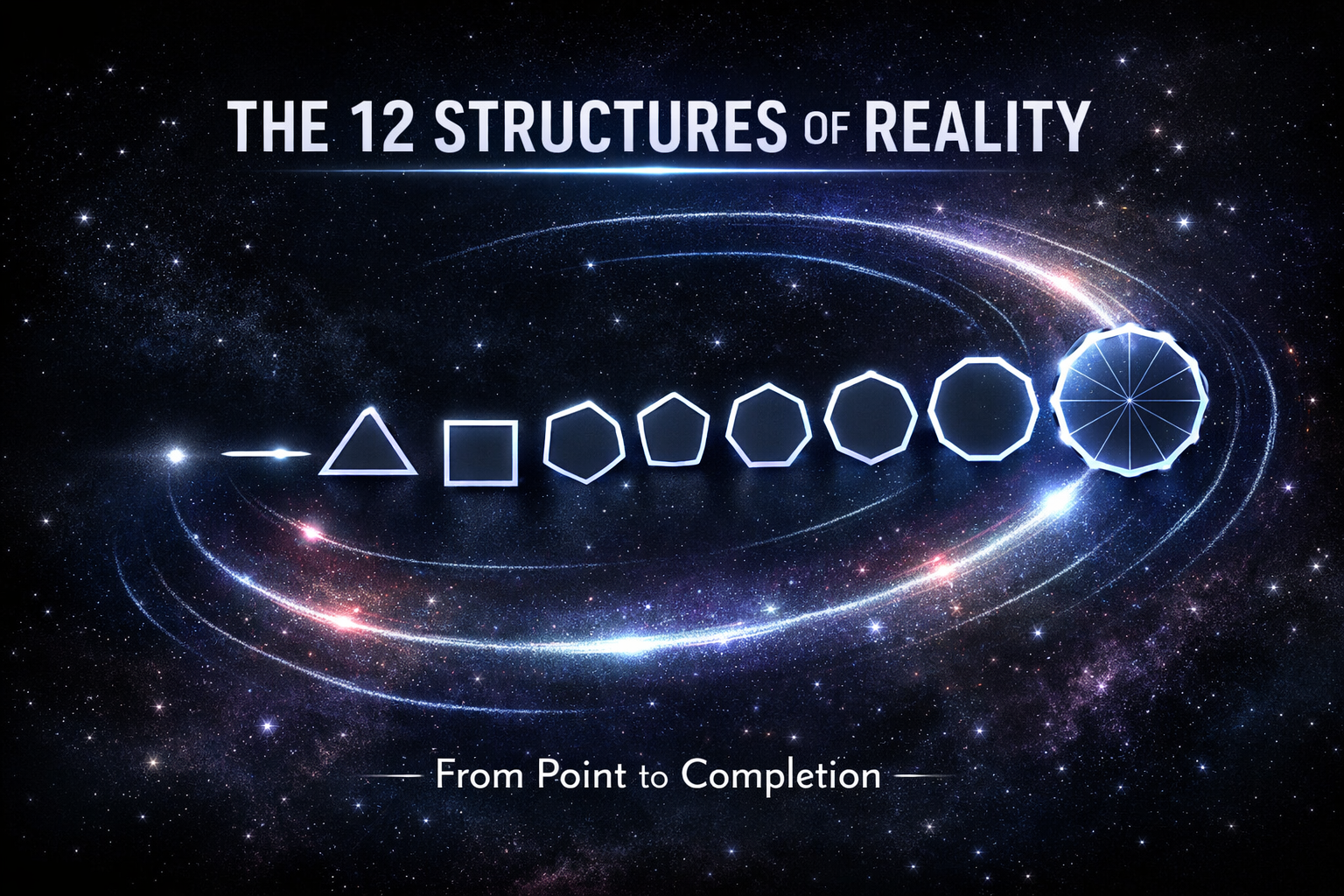
Inversion Theory: A True Theory of Everything
What if everything we see—particles, planets, galaxies, even spacetime itself—is not the foundation of reality, but the result of something deeper?
Part I: The Flat Problem — A Pattern of Misinterpretation
There is a recurring pattern in how we interpret the world—a pattern that shows up in both common misconceptions and advanced scientific models. It can be described simply as the tendency to mistake appearance for foundation. One of the clearest examples of this is what we can call the "flat problem."
At its most basic level, the flat problem appears in the idea of a flat Earth, where observation from a limited perspective leads to a false conclusion about the nature of the whole system. While this example is easy to dismiss, the underlying pattern does not disappear. It reappears in more sophisticated forms, including within cosmology itself.
Why Do We Always Go There?
Why does this pattern repeat? Because cosmology—and scientific modeling more broadly—often makes the same fundamental mistake: it begins with what is visible and measurable, then builds its explanations backward from that point.
The solar system is often described as flat, and in a limited sense, this is true. Planetary orbits tend to align along a common plane, forming what appears to be a disk-like structure. However, this does not mean the system itself is fundamentally flat. What is being observed is not flatness as a primary condition, but the result of orbital behavior—motion constrained by forces such as gravity and angular momentum.
This distinction matters more than it seems.
Flatness, in this case, is not a defining property of the system. It is an outcome. It is what happens when a dynamic system stabilizes under specific conditions. When motion is constrained, it produces patterns. When those patterns are observed without accounting for the underlying process, they are often mistaken for the structure itself.
The Mistake: Confusing Orbit with Flatness
Here's where the error becomes clearer. Angular momentum causes rotating systems to flatten over time. A cloud of gas and dust, spinning around a central mass, will gradually settle into a plane perpendicular to its axis of rotation. This is physics—it's well understood.
But the plane is not the system. The plane is a consequence of constrained motion.
When we describe the solar system as "flat," we are describing an emergent configuration, not a fundamental property. The flatness is not built into reality—it is built by dynamics over time.
This same error scales up. Galaxies are described as flat disks. The observable universe is sometimes modeled in terms of flat geometry. In each case, we are looking at stabilized outcomes and treating them as if they were foundational truths.
The flat problem, therefore, is not just about flat Earth believers or disk-shaped solar systems. It is about a deeper tendency in human observation and scientific modeling: the tendency to treat visible patterns as foundational truths.
Part III: The Two Stages of Reality
Duality is not merely the existence of two opposite states, nor is it limited to familiar scientific categories such as wave and particle. More fundamentally, duality describes a two-stage process of reality itself.
The problem is this: No current theory fully models both stages together.
Instead, they divide the system. Some frameworks focus on the measurable—geometry, structure, spacetime, particles. Others focus on the dynamic—waves, probabilities, or fields. But each approach isolates one side of the process and treats it as primary.
They do not describe the full transition.
Stage One — The Harmonic State
The first stage is the underlying generative condition—the harmonic state. This is the invisible organizing principle that governs how energy behaves, aligns, and reinforces itself.
Before structure stabilizes into form, there must be an organizing condition—something that determines how energy interacts and resolves. This harmonic layer is not directly observed as structure. It exists prior to form, defining how structure will emerge.
The harmonic state is:
- Generative — it creates the conditions for structure
- Invisible — it is not observed as form
- Organizing — it governs alignment and coherence
- Primary — it precedes all geometric expression
Stage Two — The Geometric State
The second stage is the expressed and stabilized result—the geometric state. This is the visible, measurable form that emerges once the harmonic layer resolves into structure.
What is commonly called "structure" belongs entirely to this stage. It is not the origin—it is the outcome.
The geometric state is:
- Expressive — it reveals prior organization
- Measurable — it can be observed and quantified
- Stable — it represents contained, resolved energy
- Secondary — it follows from harmonic conditions
The Core Principle
Geometry is never primary. Geometry is the aftereffect of harmonics made stable.
Form is what remains once a deeper vibrational order resolves into measurable arrangement. Without the harmonic condition beneath it, geometry would have no basis for existence, because there would be no organizing principle capable of giving rise to coherent structure.
This is the backbone of the entire framework.
This is what the theory must explain.
Part V: Einstein and the Fabric Interpretation
Now we come to one of the most influential frameworks in modern physics: Einstein's general relativity.
The problem here is not that Einstein's math failed. The problem is the interpretation that followed from it. The now-famous image of spacetime as a fabric turned gravity into a kind of flat demonstration, where mass appears to sit on space and press downward into it, like a ball on a stretched sheet. That picture is useful for showing orbital behavior, but it is still a flattened interpretation of a deeper process.
Why the Fabric Picture Is Misleading
The fabric model works as a simplified analogy because it helps visualize how motion curves around mass. In that sense, it captures part of the result. But it does so by reducing the system into a plane.
That is the same flat problem again.
A two-dimensional image is used to explain a fully surrounding interaction. The object is shown as resting on spacetime, pressing into it from above, as though the structure only deforms in one directional frame. But that is not what is actually happening.
The object is not sitting on spacetime.
It is inside of it.
What Is Actually Happening
A mass does not simply press down on a surface. It interacts with the surrounding medium in all directions. The better picture is not a ball on rubber, but a ball inside water.
When a ball is placed into water, the water does not only bend beneath it. The water wraps around it. A full boundary forms around the object. The interaction is not planar. It is surrounding.
This is much closer to what inversion describes.
The mass still bends, so to speak, but what it is really doing is inverting the surrounding field around itself. The field is displaced, reorganized, and wrapped around the object in all directions. What appears geometrically as curvature is actually the visible result of this deeper inversion process.
Why Einstein's Math Still Works
This is why the equations can still succeed even if the interpretation is incomplete.
The mathematics correctly describes the resulting behavior of objects moving within the structured region created by mass. It captures the orbital and dynamical outcome. In that sense, it works much like tracking a boat moving across water. The motion is real, the path is measurable, and the model can be predictive.
But the picture of a flat fabric is still not the actual cause.
It is a reduced image of the effect.
The true interaction is not something sitting on space and bending it downward. It is something existing within the field and inverting that field around itself.
Reframing Gravity Through Inversion
From this perspective, gravity is not best understood as an object resting on spacetime and creating a dip. It is better understood as the result of a mass generating an inversion boundary within the surrounding field.
This changes the image entirely.
The system is no longer a flat surface with dents. It is a full, surrounding structure where the source reorganizes the field around itself. The resulting geometry is real, but it is secondary. It is the visible expression of inversion, not the origin of it.
This is the deeper correction.
Einstein's equations may describe the structure of motion correctly, but the common fabric interpretation repeats the same mistake found elsewhere: it takes an emergent geometric effect and treats it as the foundational reality.
What is actually fundamental is not the flat image of curvature.
It is inversion.
Part VII: The Periodic Chart as a Map of Inversions
The periodic chart represents the known elements—the building blocks of matter as we understand them. Within this framework, these elements are not just different substances, but different expressions of stable structure.
Let us begin with the simplest: hydrogen.
Hydrogen is the first element on the chart. It consists of a proton and an electron forming a stable system. From the perspective being developed here, this is what we would call a stable inversion.
When the components that make up hydrogen come together, they do not simply attach. They interact within a harmonic field. Through this interaction, they align, synchronize, and enter into a phase lock. This is the moment where open energy transitions into a stable, self-contained structure.
This is inversion at the atomic level.
The system stabilizes, forming a boundary where the interaction becomes coherent and repeatable. What we observe as a hydrogen atom is not just a collection of parts, but a resolved harmonic system—energy that has organized into form.
The Strong Force as Inversion
In conventional physics, the force responsible for holding the nucleus together is called the strong force. It is described as a fundamental interaction that binds particles at extremely small scales.
But within this framework, that binding is not a separate force.
It is inversion.
What is being described as the strong force is the effect of energy entering a phase-locked, harmonic state—where the system reinforces itself and becomes stable. The force is the observed result of that stabilization, not the underlying cause.
This aligns with what we see in cymatics.
When vibration reaches the right conditions, matter organizes into stable patterns. At the atomic level, the same principle applies. The harmonic field defines the conditions, and inversion produces the structure.
From this perspective, the periodic chart is not just a list of elements.
It is a map of stable inversions.
Each element represents a different configuration of harmonic stability—different ways in which energy can organize, phase lock, and maintain structure within the field.
Part IX: The 12–60 Framework — Structure and Motion
The 12–60 framework defines two sides of the same system:
- 12 represents structure
- 60 represents motion
This is not arbitrary. It reflects how stable systems organize and how movement operates within them.
12 — The Structural State
The number twelve defines complete structure.
When energy stabilizes through inversion, it does not form randomly. It resolves into a finite set of stable positions. These positions define boundaries, relationships, and balance within the system.
This is why twelve appears repeatedly:
- Orbital systems
- Harmonic divisions
- Musical scales
- Time segmentation
Twelve represents contained, organized, stable arrangement.
60 — The Motion State
Sixty defines continuous motion within that structure.
Where twelve gives position, sixty gives movement between positions.
It represents:
- Rotation
- Cycles
- Progression
- Timing
This is why sixty appears in:
- Time (seconds, minutes)
- Circular measurement (360 degrees → 6 × 60)
- Harmonic subdivision
Sixty is not structure—it is the resolution of movement across structure.
Together — One System
12 and 60 are not separate ideas.
They describe a single process:
- Structure (12) defines where things can exist
- Motion (60) defines how things move through those positions
Without 12: motion has no reference.
Without 60: structure is static and meaningless.
The Core Principle
All stable systems require both:
- A finite structural arrangement
- And a continuous motion system operating within it
This is why the same pattern appears across domains:
- In cymatics → structure (nodes) + vibration (motion)
- In orbital systems → positions + rotation
- In music → notes + frequency progression
- In this framework → harmonics (structure) + inversion flow (motion)
Part XI: The 12 Basic Shapes — Derived from Structure
If the system completes at twelve, then the expectation is simple:
The number should reappear wherever structure stabilizes.
And that's what shows up.
- Time organizes into 12-hour cycles
- Cycles of motion resolve into 360 (6×60)
- Musical systems resolve into 12 notes before repeating
- Many structural and symbolic systems organize around groups of twelve
These are not identical systems, but they share a common behavior:
They reach completion, then repeat.
Twelve as Completion
Within this model, this is not treated as coincidence or symbolism alone.
It follows directly from the structure:
- Systems build through discrete stages
- Each stage adds complexity and relationship
- At a certain point, the system becomes fully defined
- Beyond that point, it does not create new structure—it repeats at a higher level
That point appears at twelve.
Shapes as Harmonic Assemblies
A shape in this system is not a singular object.
It is a harmonic assembly of simpler structures.
Like in music:
- A single note is not the full structure
- A chord is multiple notes phase-aligned
Same thing here:
- A shape is not one piece
- It is a combination of structural units in alignment
Example: A cube is not "one shape" in isolation—it is 6 squares arranged in a stable relationship.
So:
- Square = base unit
- Cube = harmonic assembly of squares
Each of the 12 structural states defines a way units can combine. The result is different compound structures (shapes).
2D as Structure, 3D as Structure in Motion
To clarify the distinction:
- 2D shapes = stable structural states
- 3D shapes = those structures moving / interacting / extending through motion
So a cube isn't just a shape—it's a square system expressed in motion and depth.
Same with:
- Sphere → circle in motion
- Cylinder → circle + linear motion
- Torus → circular motion looping through itself
Three-dimensional form is not a separate category of shape. It is structure expressed through motion.
Deriving the 12 from Geometry
Using 180° as the step of structural growth:
Now the system has:
- A true starting point (point, line)
- A clear progression
- A defined completion at 12
The Pattern Confirmed
Structure begins with position and direction, then closes into form and builds through discrete stages until it resolves into twelve.
This 12 is not:
- Arbitrary
- Symbolic
It is constructed from the system itself.
As structure scales, it increases in discrete steps until it resolves into twelve divisions. Beyond this point, the system no longer creates new structural types—it refines existing ones or repeats at a higher level.
Clean statement:
"There are not 12 shapes in the traditional sense. There are 12 fundamental structural states, and each state produces its own class of geometric expression."
Part XIII: What This Changes
If the harmonic-geometric duality is real, and if inversion is the mechanism that bridges them, several implications follow:
1. We Need to Look for the Harmonic Layer
Current physics is highly developed in its geometric descriptions. What's missing is a systematic investigation of the pre-geometric conditions—the harmonic organizing principles that make geometry possible.
2. Existing Models Can Be Extended, Not Replaced
General relativity doesn't need to be discarded. It may need to be extended. If spacetime curvature is the geometric expression of a deeper process, then understanding that process could provide access to phenomena that pure geometry cannot explain.
3. The Flat Problem Has Practical Consequences
If we consistently mistake emergent patterns for fundamental properties, we may be missing important dynamics. What else are we interpreting as foundational that is actually the result of a deeper process?
4. Duality Must Be Applied Completely
The wave-particle duality taught us that reality has multiple aspects. But we often stop at recognizing two states without asking which comes first. If harmonics precede geometry, then any dual framework must account for this sequence.
5. Structure Is Not the End—It Is the Middle
What we observe as matter, form, and arrangement is not the final state of reality. It is a stabilized phase within an ongoing process. Understanding this changes how we approach everything from physics to consciousness.
Conclusion: Looking Beyond the Fabric
The flat problem is not just about flat Earth believers or disk-shaped solar systems. It is about a deeper tendency in human observation and scientific modeling: the tendency to treat visible patterns as foundational truths.
When we recognize that:
- Flatness is constrained motion, not inherent structure
- Geometry is the second stage of a dual process
- Harmonics precede and generate geometric form
- Even spacetime curvature may be a geometric expression of something deeper
- The periodic table is a map of stable inversions
- Sound organizes matter into form
- Energy flows in spiral patterns as it structures reality
...we open the door to a more complete understanding of reality.
Inversion theory proposes that structure emerges when energy turns inward—when open, unconstrained states fold into stable, self-reinforcing patterns. What we observe as matter, form, and geometry is not the beginning of the process. It is the result.
The question now becomes: what lies beneath the fabric?
If geometry is the aftereffect of harmonics made stable, then the true foundation of reality is not the shapes we see, but the vibrational order that allows those shapes to exist.
Understanding that order—and the inversion process that translates it into form—may be the key to completing our picture of the universe.
A Universe Factor Ending
You've just read something that challenges how you see reality.
Not because it rejects what science has discovered—but because it asks what science has not yet examined.
The shapes we see are real. The equations work. The models predict.
But they describe the surface.
Beneath every particle is a field. Beneath every field is a harmonic condition. Beneath every form is a process of inversion that made that form possible.
We live in a universe that is not built from objects.
It is built from relationships.
From resonance.
From energy that learned how to hold itself together.
This is not philosophy. This is not metaphor.
This is the pattern that repeats from atoms to galaxies, from sound waves to consciousness itself.
And once you see it, you cannot unsee it.
The flat problem is everywhere—in how we model gravity, how we interpret orbits, how we understand matter itself. We keep looking at the result and calling it the cause.
Inversion theory invites you to look deeper.
To ask not just what exists, but how it came to exist.
To recognize that geometry is not the foundation—it is the flower.
The root is something else entirely.
And that root is still speaking.
Still vibrating.
Still organizing everything you see into the patterns you call reality.
This is the Universe Factor.
Welcome to the deeper layer.
This article is part of the Conscious Codex series exploring foundational principles of reality through the lens of harmonic theory and inversion.
Next: The 12 Laws of Reality — A Complete Framework