
There is something remarkable about human knowledge.
When a new technology appears, we usually see it in its earliest form. It is primitive. Over time, it develops. New generations improve it, expand it, and find new ways to use it.
But imagine a system that has been developing for more than 5,000 years. A system that has passed through civilizations, languages, religions, and empires—and is still being used today.
We don't have to imagine it. We use it every day. We see it in our clocks. We see it in the measurement of angles. And we see it in the way we divide time.
60 seconds. 60 minutes. 360 degrees.
Why Is a Clock Round?
Before we examine the numbers, consider the shape. A clock is round. We rarely stop to ask why.
The answer begins with the sky.
The Earth turns beneath us, creating the appearance that the heavens move around us. The Sun rises, crosses the sky, and sets. The stars appear to wheel around the celestial pole. And long before mechanical clocks existed, the movement of shadows provided one of humanity's earliest ways of measuring the passage of time.
The sundial translated that movement into a measurable pattern. The clock eventually transformed the same basic idea into a mechanical instrument. Its circular face became a compact representation of a much larger cycle—the apparent movement of the heavens produced by the Earth's rotation.
The Earth is a sphere. But its rotation produces a repeating circular motion across the sky. And that motion became part of the way human beings represented time.
But the shape is only half the story.
- Why twelve hours?
- Why sixty minutes?
- Why sixty seconds?
- Why three hundred and sixty degrees?
Why these numbers—and not ten, or one hundred? The answer does not come simply from the shape of the Earth. To understand the numbers, we have to go much further back.
The Sumerians
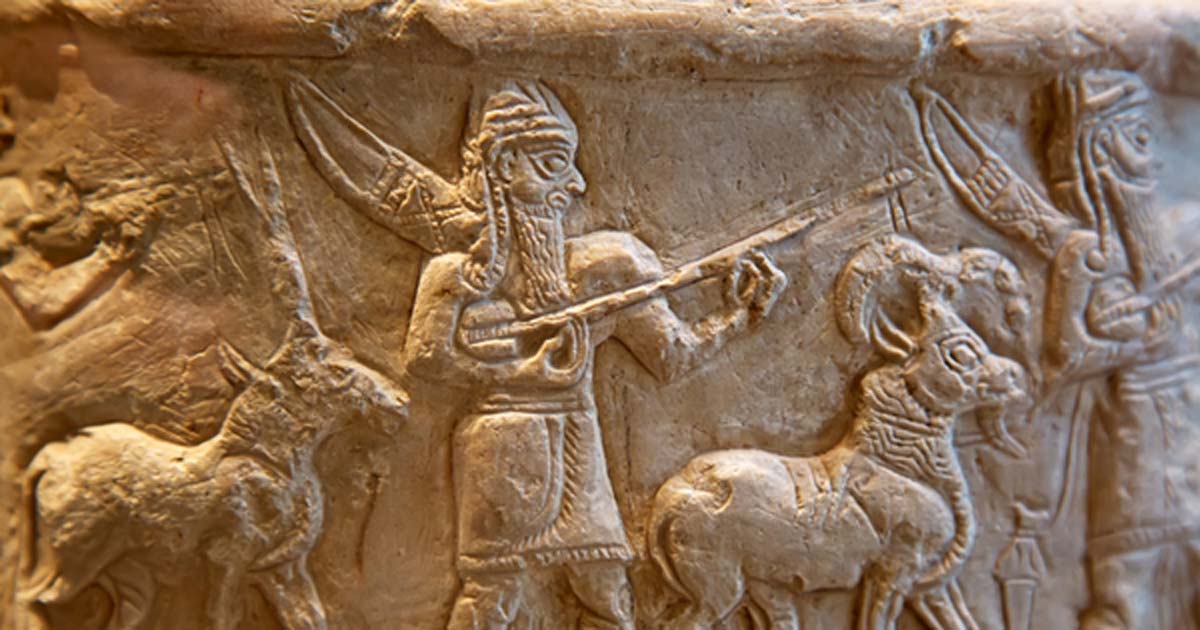
More than five thousand years ago, in ancient Mesopotamia, a civilization emerged that developed writing, cities, administration, trade, architecture, mathematics, and astronomical observation.
The Sumerians.
They watched the same sky that we see today. And they developed systems for recording, measuring, and organizing the world around them.
But there is another part of the Sumerian story that makes their understanding of knowledge especially interesting. Their traditions did not simply describe civilization as the result of human invention. They told of the gods bringing civilization and its essential knowledge to humanity.
Among those gods was Enki, associated with wisdom, knowledge, craftsmanship, and the divine powers known as the me—principles and powers associated with civilization itself.
Within this worldview, the knowledge required to build and maintain civilization could be understood as part of a larger divine order: measurement, writing, craftsmanship, organization, and knowledge of the heavens.
Whether we approach these traditions as mythology, religion, or historical evidence of how the Sumerians understood their world, they reveal something important about their conception of knowledge:
Civilization was connected to knowledge believed to come from beyond ordinary human invention.
And then we encounter one of the most enduring elements of their mathematical tradition.
60.
The Number 60
The ancient Mesopotamian mathematical tradition became associated with what we now call sexagesimal mathematics—a base-60 system.
The Sumerians established important foundations for this tradition, and Babylonian scholars later inherited and developed it. Over time, sexagesimal mathematics became deeply connected with calculation, astronomy, measurement, and the recording of time.
And thousands of years later, the system is still with us.
- We have 60 seconds in a minute.
- We have 60 minutes in an hour.
- A circle contains 360 degrees.
A mathematical tradition that emerged in the ancient world continues to shape the way modern civilization measures time and space. That alone is remarkable.
But another number repeatedly appears alongside 60.
12.
Twelve hours. Twelve months. Twelve divisions of the zodiac. Across ancient systems of time, astronomy, religion, and culture, twelve appears again and again.
And mathematically:
12 × 5 = 60
Now we have two numbers: 12 and 60. Two numbers that appear repeatedly throughout human history—in mathematics, measurement, astronomy, geometry, and religious and cultural traditions.
And this is where the investigation begins.
Because when we place 12 and 60 side by side, a relationship begins to emerge. It is more than an interesting feature of ancient history. It raises a deeper question about why these numbers endured, how they became connected, and why they remain embedded in systems we still use today.
That is what we are going to explore. Not simply what the numbers are—but why they endure. And why, more than five thousand years later, we are still living with the legacy of a system developed in the ancient world.
The Twelve Divisors
So why do these two numbers keep appearing together? Before we can answer that question, we have to understand what each number represents.
With 60, we can already begin to see a relationship with time and motion. Sixty seconds make a minute. Sixty minutes make an hour. And the movement of the clock carries us through that measurement of time.
But what about 12? What does twelve represent?
One way to begin answering that question is to look at the clock itself. The twelve numbers around the clock establish a structure. The space between 1 and 2 is one region of that structure. The space between 2 and 3 is another. And as time moves, the seconds move through those spaces.
The structure remains. The motion moves through it.
So when we say 2:30, we are not simply naming two unrelated numbers. We are identifying a position within the structure of the clock and the amount of time that has moved through that structure. Thirty minutes have passed within the second hour.
This gives us a starting point. Perhaps 12 represents structure, while 60 represents the movement or cycle through that structure.
But we need more than an example. We need to look directly at the numbers. So let's take a deeper look at 60, and ask a very simple mathematical question:
What numbers can divide 60 with no remainder?
The answer is:
1, 2, 3, 4, 5, 6, 10, 12, 15, 20, 30, and 60.
Now something immediately stands out. There are exactly 12 divisors of 60.
And that changes the question. Twelve is no longer simply a number that happens to divide 60. It is built directly into the mathematical structure of 60. The number 12 appears as the count of the divisors of 60.
Six Pairs
But there is another pattern. Take the first divisor and pair it with the last, then keep moving inward:
- 1 × 60 = 60
- 2 × 30 = 60
- 3 × 20 = 60
- 4 × 15 = 60
- 5 × 12 = 60
- 6 × 10 = 60
Now the twelve divisors have become six pairs. And something interesting happens in the arrangement.
One side moves upward: 1, 2, 3, 4, 5, 6
While the other side moves downward: 60, 30, 20, 15, 12, 10
The two sides move toward the center, and each pair produces the same result: 60.
So we have taken twelve divisors and discovered a six-pair structure. And the relationship is not simply a list of numbers. It has direction. It has symmetry. It has a center. And it has a repeating relationship between the numbers moving inward from opposite ends.
The question now becomes even more interesting. Why does 60 produce this structure? And why does the number of divisors happen to be 12?
This is where we can begin looking beyond the clock—and into the mathematics itself.
Twelve as Structure
So what do we mean when we say that 12 represents structure?
We have already seen that 60 contains exactly twelve divisors. But if twelve is truly connected to structure, we should be able to see that relationship somewhere beyond arithmetic.
One interesting example comes from a body of work known as Sonic Geometry. The idea begins with something very simple:
Geometry and sound can be connected through frequency.
In Sonic Geometry, geometric forms are explored through their angular relationships and then translated into frequencies. The process begins with basic geometric relationships and develops through increasingly complex forms.
A line establishes a relationship between two points. From there, additional lines create new structures. Three lines produce a triangle. Four produce a square. Five produce a pentagon. And the progression continues. Each new line adds another structural relationship, developing the geometry one stage at a time.
The interesting part is that these geometric structures can also be represented through angular relationships. A straight line represents 180 degrees. As the geometric structure develops, those angular relationships can be translated into frequency.
In the Sonic Geometry approach, this creates a bridge between things we normally think of as separate: geometry, frequency, and sound.
But now let's look at the progression from another perspective. Instead of asking only what sound each structure produces, let's ask: What is the structure itself?
If we continue the geometric progression, we arrive at twelve fundamental forms:
- Line
- Vesica (Digon)
- Triangle
- Square
- Pentagon
- Hexagon
- Heptagon
- Octagon
- Nonagon
- Decagon
- Undecagon
- Dodecagon
Twelve stages. Twelve structural forms.
And from these basic forms, more complex geometric structures can be created. They can be combined, repeated, rotated, nested, and expanded into increasingly complex patterns. In other words, the simpler structures become the building blocks for more complex ones.
This gives us another way to look at the number twelve. We began with a mathematical observation: 60 has twelve divisors. Now we are seeing twelve appear again as a way of organizing geometric structure.
The number itself has not changed. What has changed is the representation. First, we saw 12 in arithmetic. Now we see 12 in geometry.
And this is what we mean when we say: 12 represents structure.
It is not simply that twelve is found in a clock, a calendar, or a geometric figure. The deeper observation is that twelve can function as an organizing framework—a way of dividing, positioning, and relating parts within a larger system.
And this brings us back to 12 and 60. If twelve establishes the structural positions, then sixty can describe the movement through those positions. The clock gives us one example. Mathematics gives us another. And geometry gives us another.
But there is one more question. What happens when the structure is not drawn by lines at all? What happens when motion and frequency themselves produce the structure?
The 12–60 Structure
We have now looked at structure from two different directions.
First, we looked at the numbers themselves: 60 has twelve divisors. Then we moved into geometry, where increasing numbers of relationships produce increasingly complex forms—from the line, to the digon, to the triangle, the square, and onward through the twelve structural forms.
At this level, we are looking at the elementary structure—the basic relationships from which more complex forms can develop.
But what happens when we move beyond the geometry itself? What happens when we introduce motion?
Because a structure does not exist in isolation. It can move. It can rotate. It can vibrate. And when motion operates through a structure, something interesting can happen:
The motion can reveal the structure.
This brings us back to the relationship we began with.
- 12 represents structure.
- 60 represents motion—the cycle through that structure.
Together, they form what we are calling the 12–60 Structure.
At the elementary level, we can see the organization through geometry. But as we move upward in scale, the same relationship can become more complex. A fundamental structure can produce additional relationships. Those relationships can produce higher partials. And those higher partials can produce increasingly complex forms.
So now we have a way to look at structure across scale: from the fundamental, to the harmonic, to the larger physical form.
The question becomes: Can we actually see this relationship between motion and structure in the physical world?
Cymatics: When Sound Creates Structure
As we continue to explore 12 and 60, we can begin to see how they may represent two connected aspects of a system: 12 as structure, and 60 as motion.
And this raises another question. If structure is created, how does that creation begin? Before something can be created, its parts have to be organized.
So let's stop for a moment and ground ourselves in what we are actually saying. We have been looking at geometry, frequency, and the relationship between sound and form.
But what if sound is not simply something we hear? What if sound can also create structure? And not only create structure—but organize it.
To explore that question, we can turn to another field of study: Cymatics.
Cymatics is the study of visible patterns produced when sound or vibration acts on matter. Instead of simply hearing a frequency, we can make its effects visible.
A surface can be covered with particles, liquid, or another material. When vibration is introduced, the material begins to move. And as the vibration continues, something remarkable can happen.
The particles begin to organize. Patterns emerge. Lines form. Symmetries appear. Geometric structures develop.
The sound is invisible. The structure is visible.
And this gives us a very different way to look at the relationship we have been exploring:
- Motion creates organization.
- Organization produces structure.
- Structure can become visible.
Now we can ask a much deeper question: if vibration can organize matter into structured forms, what does that tell us about the relationship between motion, frequency, and structure?
The 12–60 Structure: An Overview
We began with something familiar. A clock. Twelve positions. Sixty minutes. Sixty seconds.
Then we went deeper. We found that 60 contains twelve divisors, creating a mathematical structure of complementary relationships. We moved from mathematics into geometry, where those relationships can be expressed through form. And we followed that structure from the elementary level through increasingly complex geometric forms.
Then we introduced motion. Frequency. Vibration. Harmonics. And we began to see how structure and motion can interact across different scales.
This is where the 12–60 Structure becomes interesting.
- 12 gives us the organization.
- 60 gives us the motion.
- Harmonics allow that motion to develop through layers of increasing complexity.
At the fundamental level, we can examine the basic structure. As harmonics develop, additional relationships appear. And as those relationships extend into larger systems, the structures can become increasingly complex.
What we have been following is not simply a number appearing in different places. We have been following a relationship: structure and motion. Organization and change. Form and frequency.
And if that relationship continues across scales, then what we have seen so far may only be the beginning. The same framework could give us a different way to examine systems far beyond the examples we have explored here—from geometry, to sound, to vibration, to physical structures, and potentially to the larger systems that surround us.
The next step is to ask how far the pattern extends, and what we might discover when we begin looking for the same relationship at completely different scales.
7 — The Process of Duality
We have now seen two fundamental relationships: 12 — structure and 60 — motion.
But there is one more element we need to understand: process. How does one state become another? How does information move from this state to that state?
To explore that, we return to the relationship we found inside 60. When we looked at the divisors of 60, we found twelve divisors that organize into six complementary pairs:
- 1 × 60
- 2 × 30
- 3 × 20
- 4 × 15
- 5 × 12
- 6 × 10
Six pairs. Six relationships. And because these relationships form a loop, we can see something that is easy to miss if we simply count the pairs. We naturally arrive at six. But the process does not end at six.
There is a seventh position: the return.
The Seed of Life
This is where we can use the Seed of Life to visualize the idea.
Look at the pattern. Six circles surround a central circle. Six around one. Seven circles in total.
The six surrounding circles establish the completed relationship around the center. The center represents the point of return. The work of the six is brought together, integrated, and carried forward.
This gives us a visual way to understand the seventh. It is not simply another position added after six. It is the integration of the cycle. The information produced through the cycle becomes part of the system. And then the system can begin again.
We can see an interesting example of this in the ancient Creation account. Creation is described across seven days. Yet the creative work occurs across the first six. The seventh day is different. It is the completion of the work. The cycle has reached its return.
And this gives us another way to look at the role of 7: seven represents the process by which the work of one cycle is integrated and carried into the next.
Think about building something from nothing. The first useful object you create becomes a tool for creating the next. That next creation adds another capability. Then another. The work accumulates. By the time the cycle is complete, the system has something that it did not have when it began. That new capability becomes part of the starting condition for the next cycle.
So the process is not simply:
A → B → C → D
It is:
A → B → C → D → integration → next cycle
Inversion and the Boundary
A cycle is more than a collection of positions. Something has to move through it. And that movement creates change.
Imagine a single point moving continuously. At first, we can describe what we see simply as motion. The point moves. That movement establishes a frequency. As the movement continues, the frequency begins to repeat. And as those repetitions become harmonically related, the motion begins to stabilize.
Now the process begins to produce something different. The movement establishes a relationship. And when that relationship becomes enclosed, we reach a point of inversion.
Inversion is enclosure. The relationship closes upon itself and establishes a boundary. And once that boundary exists, something fundamental appears: inside and outside.
This is the beginning of duality. There is now a defined state on one side of the boundary and another state on the other.
- This → that.
- Inside → outside.
- Before → after.
The process has created a distinction where there was previously only relationship in motion. And this distinction gives the system an identity.
But the process does not stop there. The harmonic relationship that created the enclosure continues. The motion continues. The frequency continues. The relationship continues to maintain the state it produced.
So the process is not motion → structure → stop. It is:
motion → relationship → inversion/enclosure → inside/outside → continued process
Duality is not simply two things. It is the relationship between two states created by the process. One state becomes distinguishable from another. And once that distinction exists, information can exist between them. The system can now have a state, interact with another state, and change from one condition to another.
The Cycle Remembers
Return to the Seed of Life. Six circular movements establish a complete relationship around a center. The center is not simply another movement made by the point. It emerges from the relationship of the six. The six movements have produced a new condition—and that condition becomes the reference for what comes next.
So when the cycle begins again, it does not begin with exactly the same information. It begins with the result of the previous cycle. The process carries the result forward.
The seven is not simply one, two, three, four, five, six, seven. It is:
one → two → three → four → five → six → integration → next one
The seventh is the point where the completed process becomes part of the next beginning. A system begins with a condition. It moves. It interacts. It changes. It becomes enclosed. It establishes a new state. And that state becomes part of the condition from which the next cycle begins.
The cycle remembers. And because it remembers, the next cycle is not simply a repetition of the previous one. It is a continuation.
- 12 — Structure. Structure establishes the relationships.
- 60 — Motion. Motion moves through them.
- 7 — Process. Process carries what was produced from one cycle into the next.
Once we see the loop, seven is no longer simply the number after six. It is the point where one cycle becomes the foundation for the next. And now we can begin to ask a much deeper question: What happens when this process operates across scale?
Closing — The Master Pattern
We began this investigation with two numbers: 12 and 60. At first, they appeared to be nothing more than numbers we inherited from the ancient world. But as we followed them, a larger relationship began to emerge.
12 gave us structure. 60 gave us motion.
And then we found something else: 7. Not simply as another number, but as the process that allows one cycle to become the foundation for the next.
We saw it in the Seed of Life. Six movements establish the surrounding structure. And at the center, the result of those relationships is integrated. The next cycle does not begin empty. It begins with what the previous cycle has produced.
The cycle remembers.
And that may be one of the most important ideas in this entire investigation. Because reality, as we experience it, does not simply repeat. It develops.
A living system encounters something. It responds. It processes the experience. It integrates the result. And that result changes the condition from which the next experience begins. The process maintains the relationships that allow the system to continue.
For an animal, that may be as immediate as finding food, avoiding danger, or maintaining the conditions necessary for survival. For a conscious being, the purpose of that process may extend much further. It may involve learning. Growth. Relationships. Purpose. And the development of consciousness itself.
So perhaps the loop is not the destination.
The loop is the mechanism through which the system continues toward its purpose.
And this brings us to a much larger question. We have been calling this investigation 12–60–7. But what if this relationship is more than a useful framework? What if the same pattern is appearing at different levels of reality?
Science has spent centuries searching for the underlying mathematics that can explain the behavior of the universe. Metaphysics has searched for the underlying pattern of existence. Spiritual traditions have spoken of an order behind creation—a pattern that connects existence, consciousness, and purpose. And the biblical tradition goes even further, presenting God as the ultimate source and order of creation.
Different languages. Different traditions. Different approaches. But perhaps they are all asking a variation of the same question:
Is there a fundamental pattern beneath everything we experience?
And if there is—what would that pattern look like?
Could structure, motion, and process be three parts of something much larger? Could the same relationship that organizes a simple cycle also appear in the development of increasingly complex systems? Could information gathered through one cycle actually become part of the identity of the system entering the next?
And if that is true, then we have reached the edge of our investigation. Because there is one thing we have not yet fully explored: life itself.
Not life simply as a collection of biological processes, but life as a system that senses, responds, processes information, maintains relationships, integrates experience, and carries the result forward. A system that does not simply repeat its cycles—but develops through them.
So perhaps the next question is not What is the pattern?
Perhaps the next question is: What happens when the pattern becomes intelligent?
Next: LIFE
That is where our next investigation begins.
LIFE — Living Intelligent Fractal Energy.
A new exploration of whether the same structure we have been following through mathematics, geometry, motion, process, and consciousness continues into the living systems we call ourselves.
Because if the cycle carries information forward, if integration changes the state of what comes next, and if each new cycle becomes part of a larger, continuing whole, then perhaps life is not simply moving through the pattern.
Perhaps life is the pattern learning through itself.
12–60. Ancient knowledge, still with us.